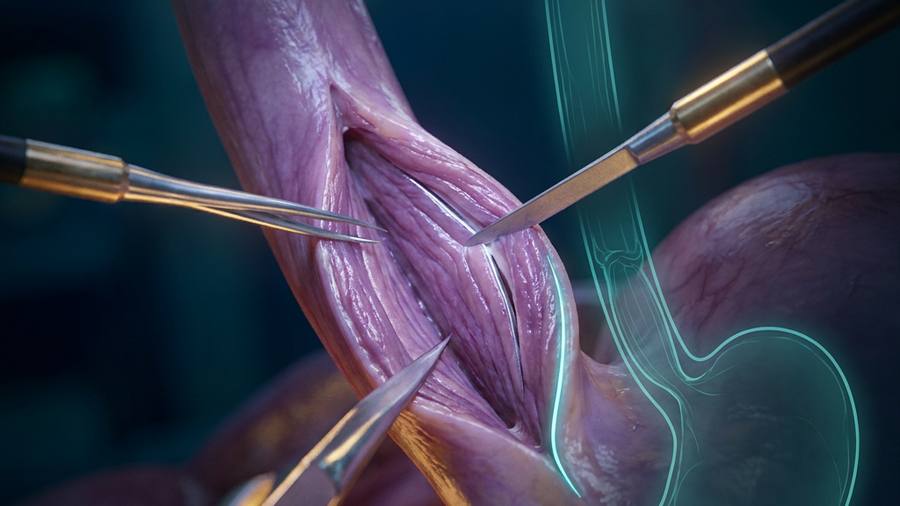
Achalasia
Laparoscopic Heller myotomy — the gold-standard surgical treatment
Achalasia is a rare swallowing disorder. The ring of muscle where your esophagus meets your stomach won’t relax the way it should, and the esophagus loses its normal squeezing motion. Food and drink collect in the esophagus instead of passing into the stomach — so swallowing slowly becomes harder over time. The good news: a keyhole operation can fix the mechanical problem and let you eat and drink comfortably again.
What is achalasia?
Your esophagus is the tube that carries food from your throat to your stomach. At the bottom is a valve (the lower esophageal sphincter) that opens to let food through, then closes. In achalasia, this valve stays tight and the esophagus stops pushing food downward. The result is food and liquid backing up instead of going down. It’s not caused by anything you did, and it isn’t cancer — but it does need treatment to manage.
Signs & symptoms
- Trouble swallowing — both solid food and liquids feel stuck
- Bringing food back up (regurgitation), especially when lying down
- Chest pain or pressure after eating
- Heartburn-like burning that doesn’t respond to usual reflux medicine
- Slow, unplanned weight loss
- Coughing or choking at night
How it’s diagnosed
- High-resolution manometry — a thin tube measures the muscle pressure in your esophagus. This confirms the diagnosis and its type.
- Barium swallow — you drink a chalky liquid and an X-ray shows the classic narrowed “bird-beak” shape.
- Upper endoscopy — a small camera looks inside to rule out other causes.
Treatment options
- Heller myotomy — keyhole surgery to release the tight valve. The most durable, long-lasting fix.
- Balloon dilation — stretching the valve open; may need to be repeated.
- Botox injection — relaxes the valve temporarily; useful for some patients.
- POEM — a newer scope-based technique done through the mouth.
Laparoscopic Heller myotomy
Through a few small keyhole cuts in the abdomen, Dr. Irshad carefully divides the tight muscle fibres of the lower esophageal valve so food and liquid can pass freely again. To stop acid from washing back up afterward, this is usually paired with a partial wrap (fundoplication) using part of your own stomach.
Because it’s done with keyhole techniques, most patients have less pain, only a one- to two-night hospital stay, and a quick return to everyday life. For most people the improvement in swallowing is dramatic — many describe eating a normal meal for the first time in years.
Your recovery, step by step
1–2 nights. Most patients go home the day after surgery.
Soft diet — soups, yoghurt, mashed foods. Avoid bread and tough meats while things heal.
Gradual return to a regular diet. Many notice a big improvement in swallowing.
Follow-up visit and full return to normal activity.
Common questions
Are there different types of achalasia?
Will I have heartburn or reflux after surgery?
How does POEM compare to Heller myotomy?
Will my swallowing be completely normal after surgery?
What tests will I need before surgery?
Is achalasia curable?
Preparing for your surgery at William Osler
Your operation takes place at William Osler Health System (Brampton Civic Hospital). These are the hospital’s general instructions for getting ready, the day itself, and afterwards — always follow any specific advice Dr. Irshad gives you. Full details are on the Osler Surgical Services page.
Before your surgery
- Do not eat anything (including gum) after midnight the night before. Unless told otherwise, you may have clear fluids — water, pulp-free juice, black coffee or tea — up to 2 hours before.
- No alcohol, smoking, or marijuana for 24 hours before surgery.
- Shower the evening before and the morning of surgery (with chlorhexidine soap if you have it). Skip lotion, perfume, makeup and nail polish.
- Bring your OHIP card and photo ID, all your medications in their original containers (inhalers, insulin, supplements), and your CPAP machine if you use one.
- Arrange a responsible adult to drive you home — a taxi, Uber or Lyft does not count, and surgery may be cancelled without one.
- Leave jewellery, money and valuables at home.
The day of your surgery
After your surgery
The pre-anaesthesia clinic
Medically reviewed by Dr. Kashif Irshad, MD, MSc, FRCSC · Last updated July 2026
A referral from your family doctor or specialist is all that’s needed to be seen by Dr. Irshad. Find the referral forms and clinic details below.
Referral information →