Hiatus hernia & reflux
Laparoscopic repair & fundoplication
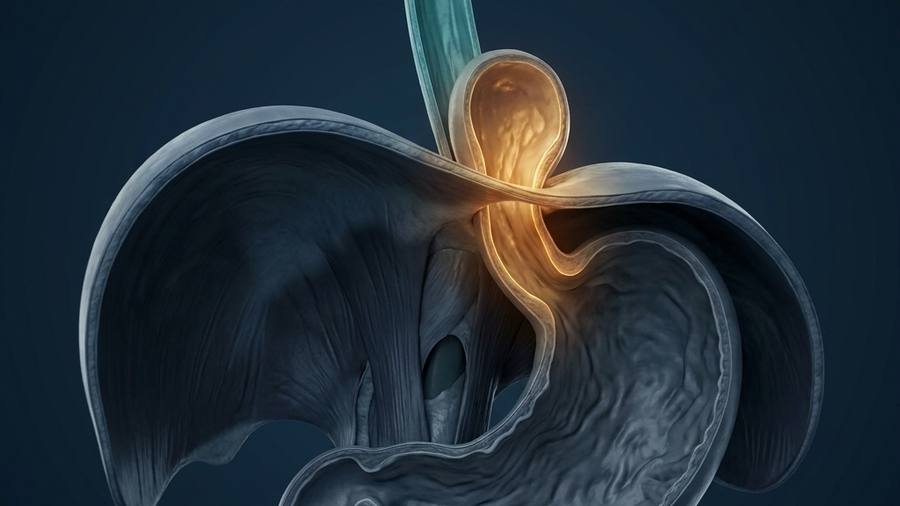
A hiatus hernia happens when part of your stomach slips up through the diaphragm — the muscle that separates your chest from your belly. It often causes heartburn and acid reflux. A keyhole repair puts the stomach back in place and rebuilds the valve so reflux is controlled. Dr. Irshad performs over 100 of these repairs a year, including large, complex hernias.
What is a hiatus hernia?
Normally your stomach sits below the diaphragm. In a hiatus hernia, part of it pushes up into the chest through an opening called the hiatus. Small ones may cause only mild reflux; large (paraesophageal) hernias can cause pain, trouble swallowing, or breathing problems.
Signs & symptoms
- Frequent heartburn or acid reflux
- Food or liquid coming back up
- Chest or upper-tummy discomfort
- Trouble swallowing
- Feeling full very quickly
- Reflux that wakes you at night
How it’s diagnosed
- Upper endoscopy to look inside
- Barium swallow X-ray
- Sometimes manometry and pH testing — these measure the valve and muscle and how much acid comes up, and help guide the type of wrap
Surgical options
- Nissen fundoplication (full 360° wrap) — the gold standard for severe reflux
- Toupet (partial 270° wrap) — gentler on swallowing
- Paraesophageal repair — returning the stomach, closing the gap (sometimes reinforced with a biologic mesh) and adding a wrap
Laparoscopic repair
Through a few keyhole cuts, Dr. Irshad returns the stomach to its proper place, closes the widened opening in the diaphragm, and builds a new valve from part of your own stomach to stop reflux.
Even very large hernias can almost always be fixed this way, rarely needing open surgery. Most patients go home the same day or after one night.
Your recovery, step by step
Same-day or one overnight stay for most patients.
Soft diet of mashed and pureed foods; no heavy lifting.
Gradual return to normal eating; some temporary bloating is normal.
Full return to normal activities, including exercise.
Common questions
Will I still be able to burp or vomit after a fundoplication?
My hernia is very large — is keyhole surgery still possible?
I’ve been on antacids for years. Do I really need surgery?
Preparing for your surgery at William Osler
Your operation takes place at William Osler Health System (Brampton Civic Hospital). These are the hospital’s general instructions for getting ready, the day itself, and afterwards — always follow any specific advice Dr. Irshad gives you. Full details are on the Osler Surgical Services page.
Before your surgery
- Do not eat anything (including gum) after midnight the night before. Unless told otherwise, you may have clear fluids — water, pulp-free juice, black coffee or tea — up to 2 hours before.
- No alcohol, smoking, or marijuana for 24 hours before surgery.
- Shower the evening before and the morning of surgery (with chlorhexidine soap if you have it). Skip lotion, perfume, makeup and nail polish.
- Bring your OHIP card and photo ID, all your medications in their original containers (inhalers, insulin, supplements), and your CPAP machine if you use one.
- Arrange a responsible adult to drive you home — a taxi, Uber or Lyft does not count, and surgery may be cancelled without one.
- Leave jewellery, money and valuables at home.
The day of your surgery
After your surgery
The pre-anaesthesia clinic
Medically reviewed by Dr. Kashif Irshad, MD, MSc, FRCSC · Last updated July 2026
A referral from your family doctor or specialist is all that’s needed to be seen by Dr. Irshad. Find the referral forms and clinic details below.
Referral information →